

What every agency owner must know before going to market
If you’re considering selling your insurance agency, there’s a critical truth most owners discover too late: the work you do before going to market determines whether you receive a premium valuation or leave hundreds of thousands of dollars on the table. The difference between a well-prepared agency and an unprepared one isn’t marginal—it can mean 20-30% swings in your final sale price.
This comprehensive guide covers everything you need to know to prepare for a successful sale, from establishing the right timeline to addressing operational issues that can kill deals during due diligence.
Preparing your insurance agency for sale
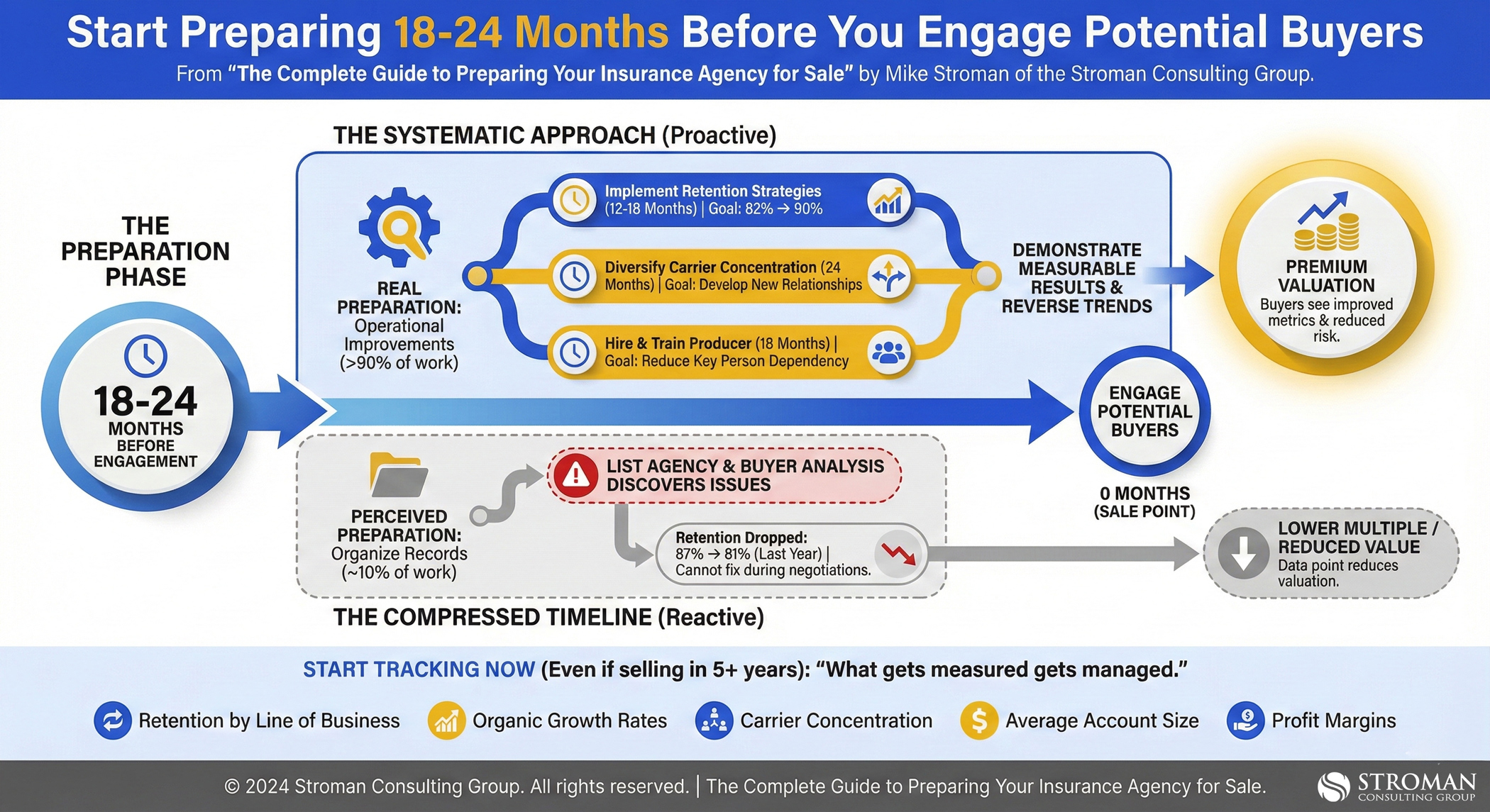
This timeline isn’t arbitrary—it’s based on the actual time required to resolve issues that reduce your agency’s value and implement improvements that increase it. Most owners believe preparation involves organizing financial records and updating the client database. That’s perhaps 10% of the actual work. The real preparation involves operational improvements that take time to demonstrate measurable results.
Consider the math: implementing retention strategies can improve your 82% retention rate to 90%, but it takes 12-18 months to show up in the numbers. Diversifying away from carrier concentration by developing new relationships and moving business takes 24 months. Hiring and training a producer to reduce key person dependency takes 18 months before they’re truly productive.
Here’s what happens when you compress this timeline: You list your insurance agency, a buyer analyzes your financials, and they discover your retention dropped from 87% to 81% last year. You can’t explain it away or fix it during negotiations—it’s a data point that reduces your multiple. But if you’d discovered this issue many months before the sale, you could have implemented a renewal review process, improved customer service, and shown the trend reversing by the time buyers see your numbers.
The owners who get premium valuations didn’t accidentally build great agencies—they systematically addressed weaknesses well before any conversations started. Even if you’re not planning to sell for five years, start tracking the metrics buyers care about now: retention by line of business, organic growth rates, carrier concentration, average account size, and profit margins. What gets measured gets managed.
The red flags that kill agency valuations
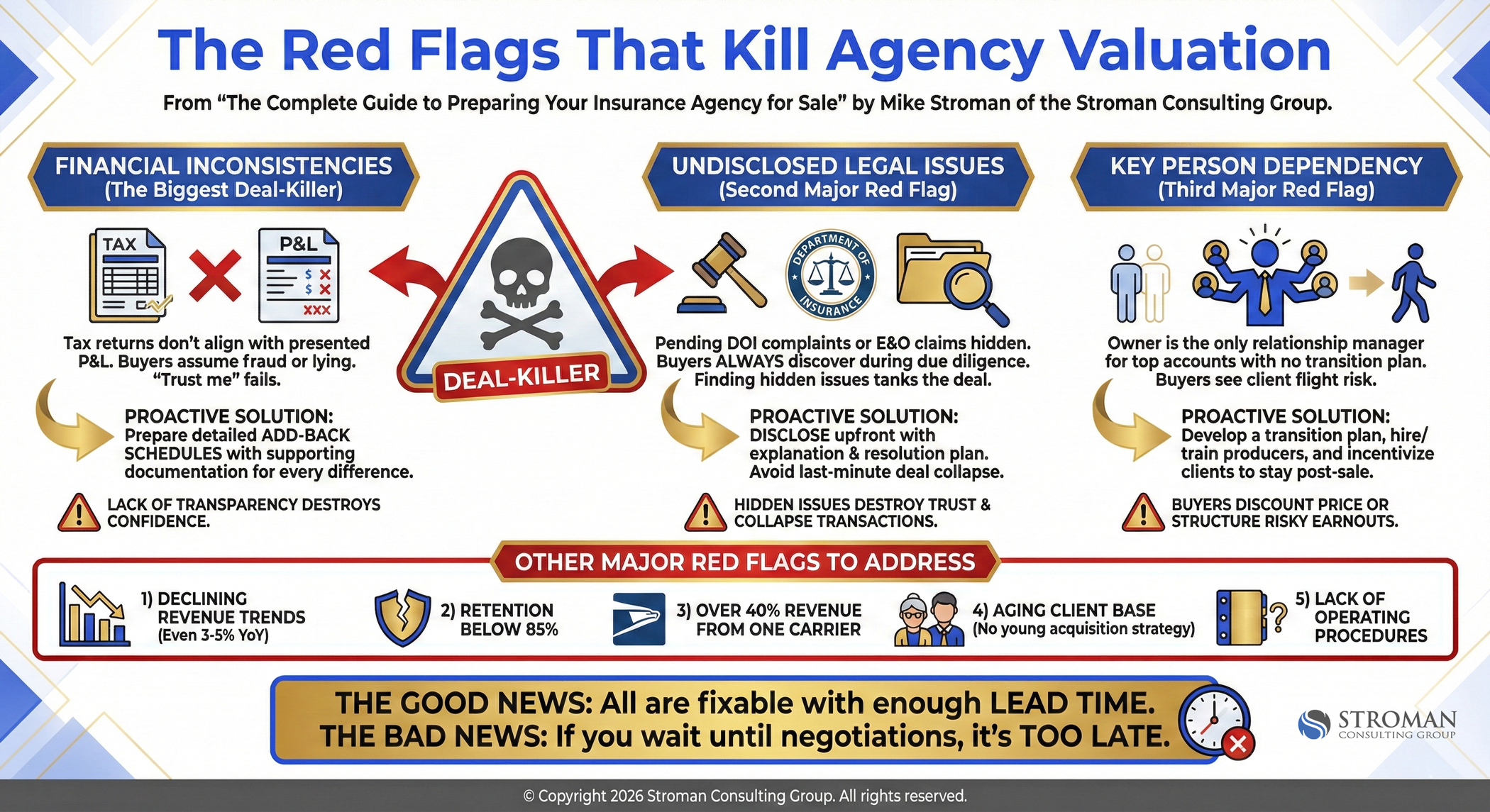
Buyers frequently walk away from deals or dramatically reduce their offers when they discover issues that signal potential risk. Understanding these red flags before you go to market lets you address them proactively rather than making excuses during negotiations.
Financial inconsistencies are the biggest deal-killer. When your tax returns don’t align with the profit and loss statement you’ve presented, buyers assume you’re either committing tax fraud or lying to them—neither builds confidence. If you’ve legitimately been aggressive with deductions, prepare detailed add-back schedules that explain every difference, supported by documentation. “Trust me, my accountant handled it” doesn’t work.
Undisclosed legal issues come second. If you have pending Department of Insurance complaints, even minor ones, disclose them upfront with an explanation and resolution plan. Buyers will discover them during due diligence anyway, and finding out you hid something destroys trust and tanks the deal. Transactions have collapsed 72 hours before closing because an owner failed to disclose a 3-year-old E&O claim they believed was irrelevant.
Key person dependency that you haven’t acknowledged is the third major red flag. If you’re the rainmaker, closer, and relationship manager for your top 50 accounts, and you have no transition plan or incentives for clients to stay post-sale, buyers will heavily discount your price or structure earnouts that put most payment at risk. They’re buying a business, not buying the right to hope your clients stick around after you leave.
Other major red flags include declining revenue trends (even 3-5% year-over-year raises serious questions), retention below 85%, over 40% of revenue from one carrier, an aging client base with no young client acquisition strategy, and a lack of basic operating procedures that document how work gets done.
The good news. All of these are fixable with enough lead time. The bad news. If you wait until you’re in negotiations, it’s too late.
The employee communication dilemma
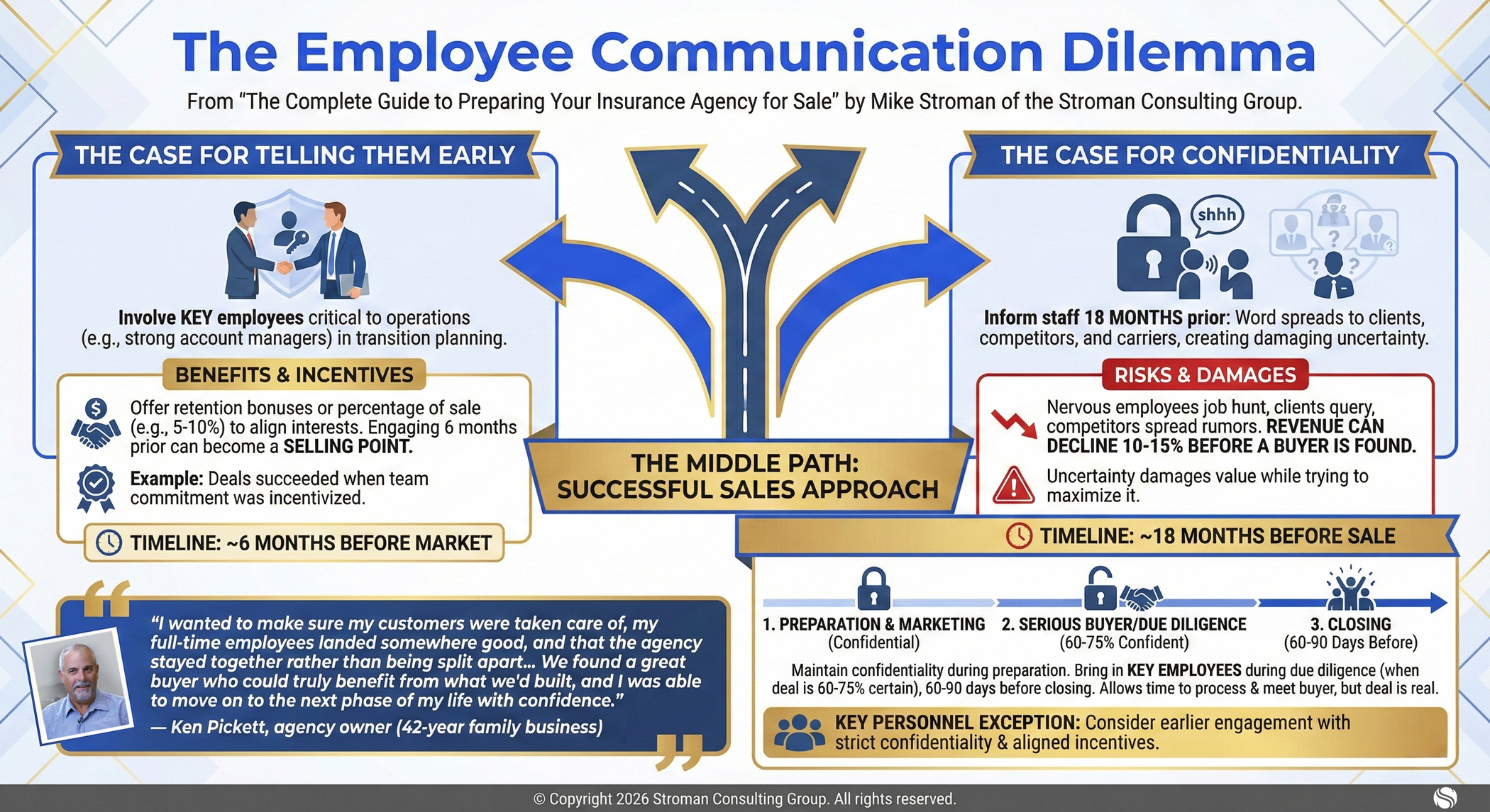
Deciding whether to tell your employees you’re planning to sell is one of the toughest decisions in the process, and there’s no universal right answer—it depends on your specific situation, employee dynamics, and timeline.
The case for telling them early: If you have key employees who are critical to successful operation, they need to be part of your transition planning. A strong account manager with deep client relationships adds value to buyers, but only if you can assure them that the person will remain. Engaging them early, potentially with retention bonuses tied to the sale, protects your transaction and rewards loyalty. Deals have succeeded when the owner brought key people into the process six months before going to market, offered them 5-10% of sale proceeds, and this became a selling point to buyers—”the team is committed and incentivized to stay.”
The case for confidentiality: People talk. If you inform your staff 18 months before the sale, word will spread to clients, competitors, and carriers—creating uncertainty that damages your business while you’re trying to maximize value. Nervous employees start job hunting. Concerned clients start calling, asking if they should look for new agencies. Competitors spread rumors that you’re closing down. Your revenue can decline 10-15% simply due to uncertainty before you even have a buyer.
The middle path most successful sales take: Maintain confidentiality during preparation and marketing phases. Once you have a serious buyer and are entering due diligence (which means you’re 60-75% confident a deal will close), bring in your key employees—usually 60-90 days before closing. This is late enough that the deal is real, but early enough that they have time to process and meet the buyer. For your key personnel whose departure would materially harm the transaction, consider informing them earlier with clear expectations about confidentiality and incentives that align their interests with yours.
“I wanted to make sure my customers were taken care of, my full-time employees landed somewhere good, and that the agency stayed together rather than being split apart… We found a great buyer who could truly benefit from what we’d built, and I was able to move on to the next phase of my life with confidence.”
— Ken Pickett, agency owner (42-year family business)
Technology and systems: What buyers actually care about
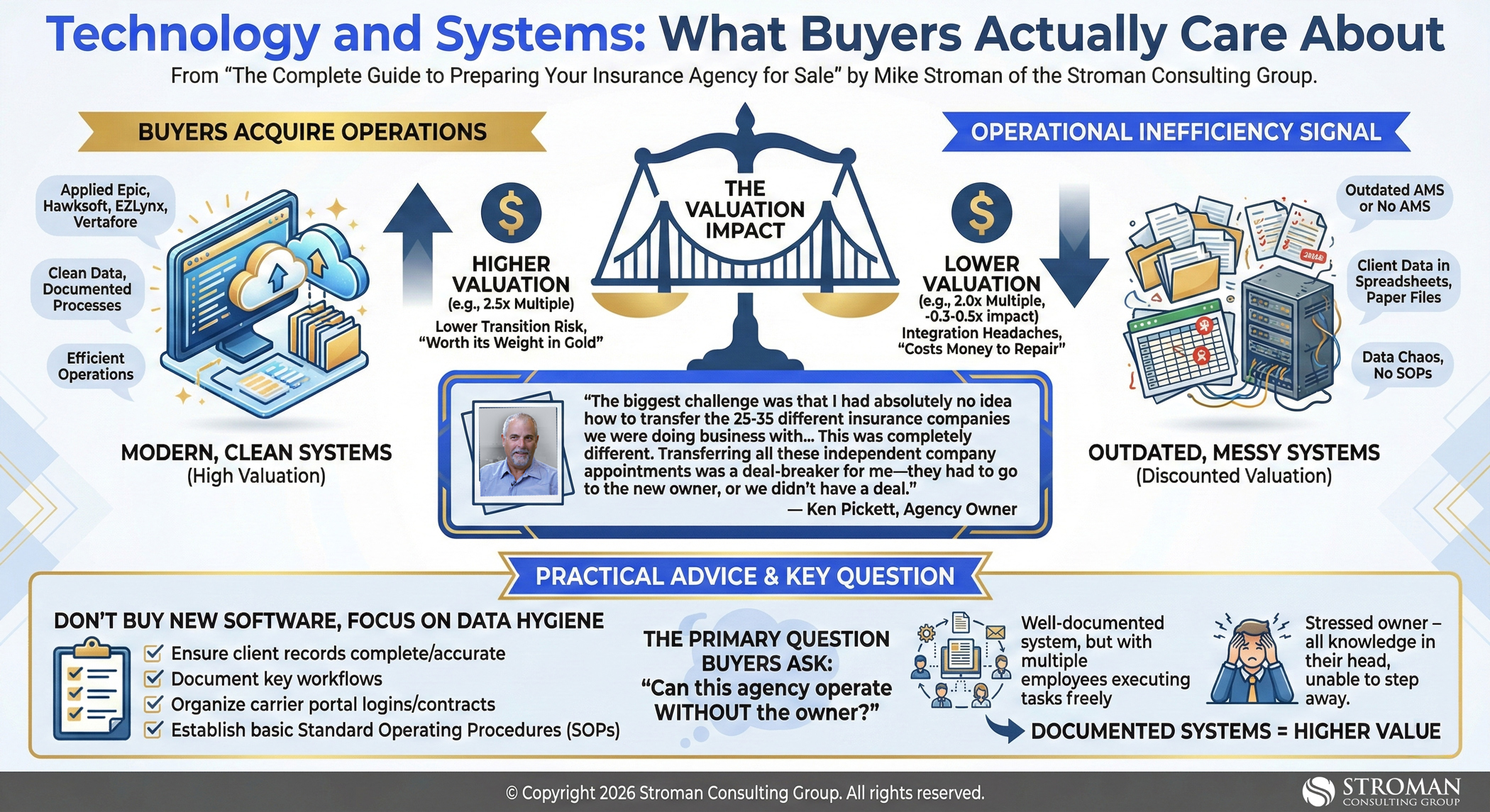
Your technology stack has a direct impact on your valuation, sometimes more than owners realize. Buyers aren’t just acquiring clients—they’re acquiring operations, and they’re evaluating how much work it’ll take to integrate your agency into their systems.
If you’re still running on an outdated agency management system, maintaining client data in spreadsheets, or using paper files for documentation, you’re signaling operational inefficiency that buyers will discount. A modern AMS (Applied Epic, Hawksoft, EZLynx, Vertafore) that’s properly implemented with clean data is worth its weight in gold because it reduces the buyer’s integration headaches. Messy or outdated systems cost money because the buyer has to repair or replace them.
Here’s the specific impact: An agency using current technology with clean data typically gets valued at the higher end of the multiple range (2.5x vs. 2.0x) because transition risk is lower. An agency with data chaos—client information in various places, incomplete records, no documentation of processes—might see 0.3-0.5 knocked off their multiple because the buyer has to spend time and money cleaning it up.
“The biggest challenge was that I had absolutely no idea how to transfer the 25-35 different insurance companies we were doing business with. When my dad sold the agency to me years ago, there were only two or three companies involved. This was completely different. Transferring all these independent company appointments was a deal-breaker for me—they had to go to the new owner, or we didn’t have a deal.”
— Ken Pickett, Agency Owner
That said, don’t buy a $50,000 software system six months before you plan to sell. Buyers will have their preferred platforms and will likely migrate to them anyway. Instead, focus on data hygiene: ensure your client records are complete and accurate, document your key workflows, organize your carrier portal logins and contracts, and establish basic standard operating procedures.
The primary question buyers ask about technology is: “Can this agency operate without the owner?” If you’re the only person who knows how everything works and it’s all stored in your head, your agency is worth less than one where documented systems allow staff to execute without constant owner involvement.
Maintaining performance without burning out
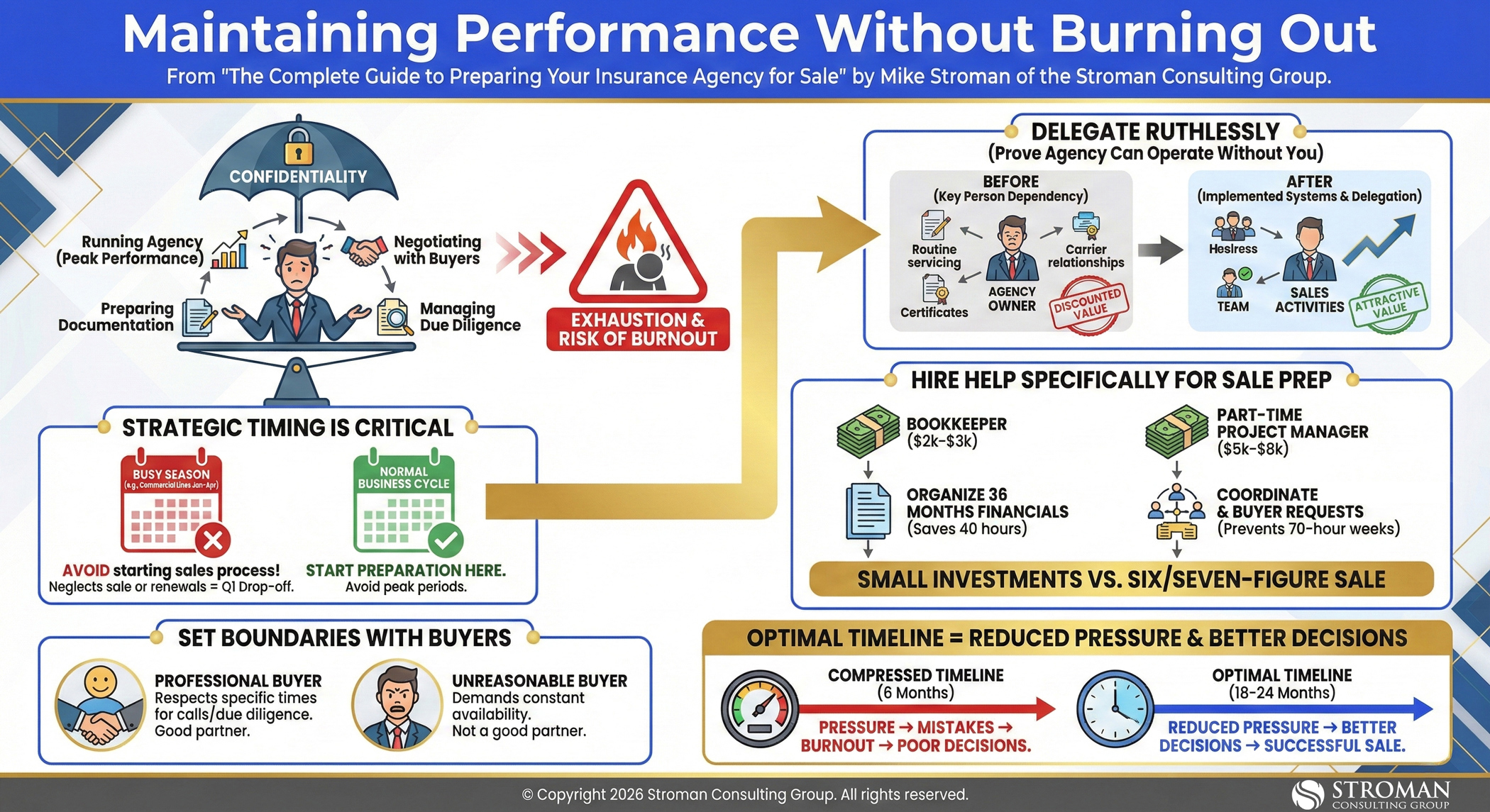
This challenge kills deals more than owners admit. You’re trying to run your agency at peak performance (because buyers will scrutinize your last 36 months), prepare mountains of documentation for sale, negotiate with buyers, and manage due diligence—all while keeping the fact that you’re selling confidential. It’s exhausting.
“The moment we put the word out, we were absolutely bombarded with inquiries. Everyone wanted financials, loss runs, valuations—the requests were overwhelming. I remember telling my husband Billy, ‘I can’t manage all of this paperwork while still doing my job.’”
— Deni Townsend, Third-Generation Agency Owner
Start preparation during your normal business cycle, not during your busiest season. If you’re a commercial lines agency with heavy January-April renewals, avoid starting your sales process in February. You’ll either neglect the sale process or neglect your renewals—and buyers will notice if your Q1 production drops off.
Delegate ruthlessly. This is precisely the time to prove your agency can operate without you anyway. If you’re still personally handling routine servicing, processing certificates, or managing every carrier relationship, buyers will discount your value because of key person dependency. Use the sale preparation as motivation to finally implement the delegation and systems you’ve been postponing. Your agency runs better, you free up time for sales activities, and you simultaneously make your business more attractive to buyers.
Hire help specifically for sale preparation. A bookkeeper to organize 36 months of financial statements costs $2,000-$3,000, but saves you 40 hours. A part-time project manager to coordinate documentation and buyer requests costs $5,000-$8,000, but prevents you from working 70-hour weeks for six months. These are small investments compared to a six- or seven-figure sale.
“Instead of sending documents to ten different people and repeating our agency’s story over and over, I could send everything to Mike. He reformatted materials as needed and handled all the back-and-forth. Our process took about seven months (including a COVID delay), and we closed on June 1st.”
— Deni Townsend, Third-Generation Agency Owner
Set boundaries with buyers. You don’t need to respond to information requests within 2 hours. Establish specific times for calls and due diligence activities that don’t disrupt your agency operations. Professional buyers respect boundaries; unreasonable buyers who demand constant availability are unlikely to be good partners anyway.
Most importantly, give yourself 18-24 months for the total process, not 6 months. Compressed timelines create pressure that leads to mistakes, burnout, and poor decisions.
Handling E&O claims and customer complaints
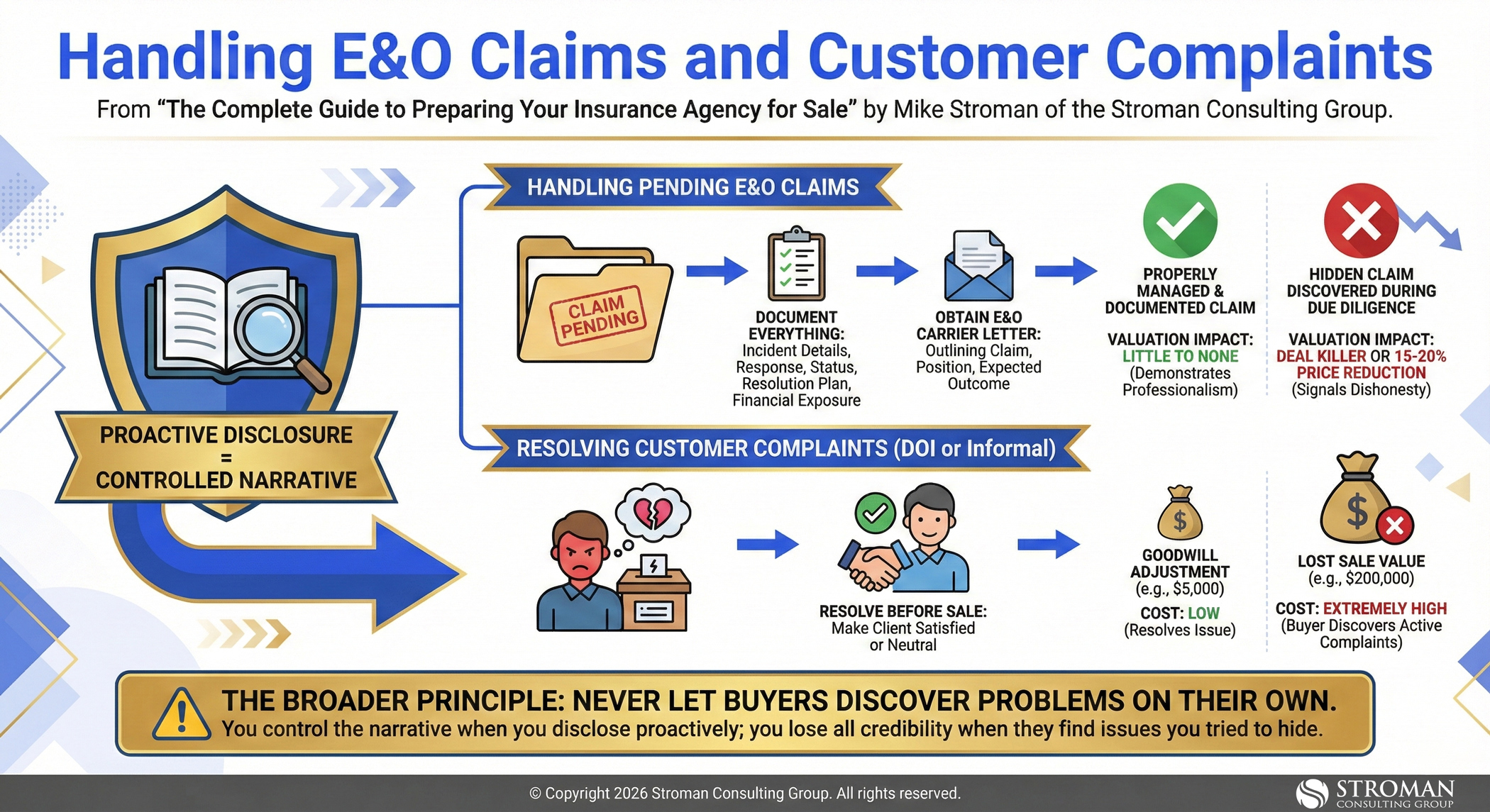
Address pending claims and complaints head-on before marketing your agency, and definitely before due diligence begins. Trying to hide them is futile—buyers will discover them through carrier conversations, DOI records, or their own due diligence process—and the cover-up is worse than the original issue.
For pending E&O claims, document everything: what happened, how you responded, current status, expected resolution, and financial exposure. If your E&O carrier is handling the matter, obtain a letter from them outlining the claim, their position, and the expected outcome. Buyers want to understand the potential liability they might be assuming, but more importantly, they want to see that you handle problems professionally.
A properly managed E&O claim with clear documentation might not impact your valuation at all. A hidden claim discovered during due diligence will tank your deal or knock 15-20% off your price because it signals dishonesty and raises questions about what else you’re hiding.
For customer complaints—whether formal DOI complaints or informal grievances—resolve them before the sale if possible. If you have an angry client threatening to file a complaint, spend the time and money to make them satisfied or at least neutral. A $5,000 goodwill adjustment that resolves a complaint is infinitely cheaper than losing $200,000 off your sale price because a buyer discovers active complaints during due diligence.
The broader principle: Never let buyers discover problems on their own. You control the narrative when you disclose proactively; you lose all credibility when they find issues you tried to hide.
Why aggressive pre-sale growth often backfires
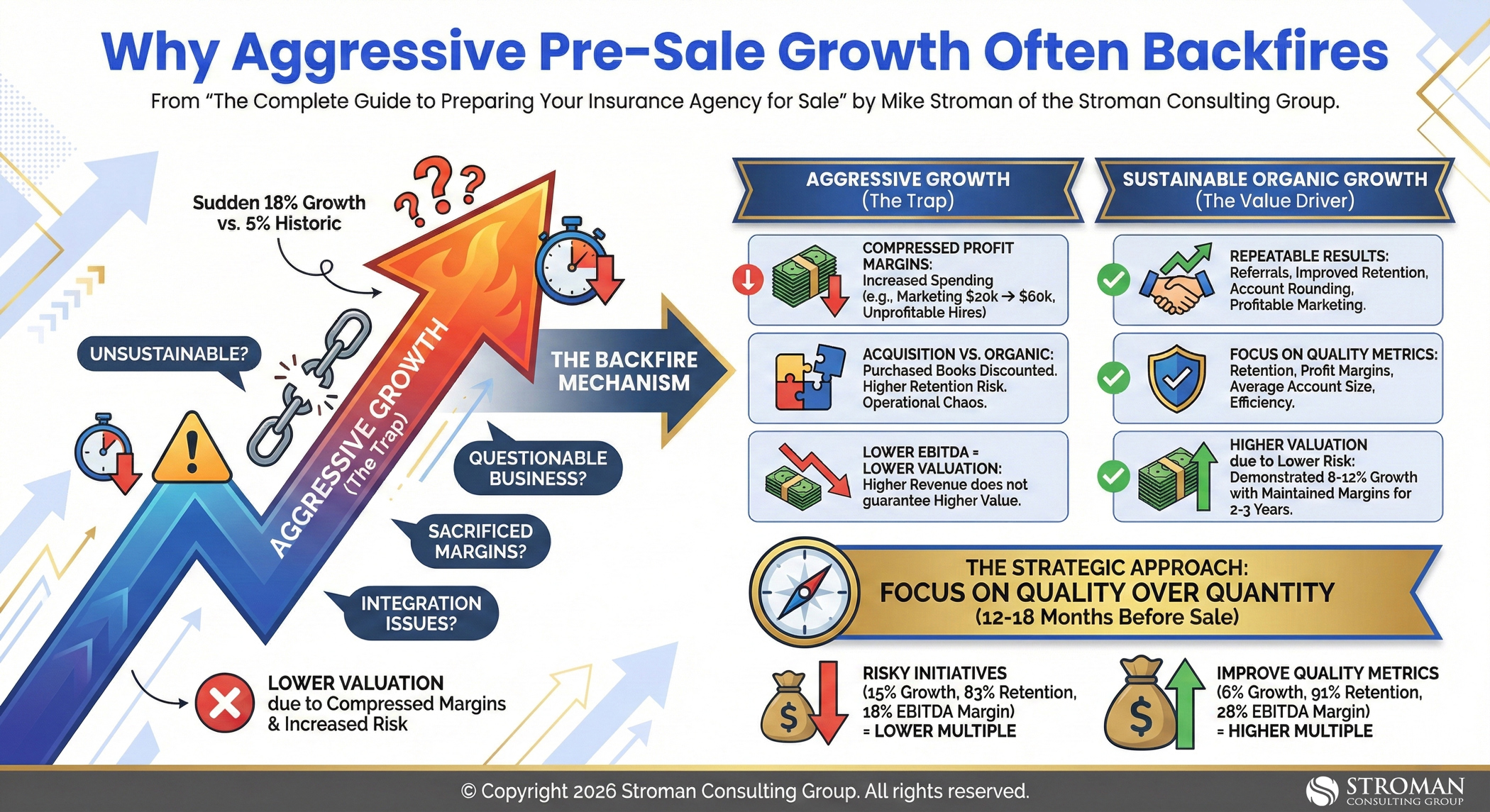
The instinct makes sense—more revenue equals a higher sale price—but aggressive growth right before the sale often backfires and can actually reduce your valuation if done wrong. When selling an insurance agency, buyers analyze growth quality, not just growth quantity.
If your agency has been growing at 5% annually for years and suddenly shows 18% growth in the year before sale, buyers will ask tough questions: Is this growth sustainable? Did you sacrifice profit margins to generate it? Are you writing questionable business that will blow up after the sale? Did you purchase a book of business that hasn’t been integrated yet?
Here’s where aggressive pre-sale growth hurts you: If you’ve ramped up marketing spending from $20,000 to $60,000 annually to drive growth, your profit margins are compressed. Buyers pay on multiples of revenue or EBITDA—if your EBITDA dropped because of growth spending, you might have higher revenue but lower valuation. If you’ve hired producers who aren’t yet profitable, the same problem applies.
If you’ve purchased books of business to inflate revenue, buyers will heavily discount that “growth” because it’s an acquisition, not organic, and the retention risk is higher on purchased books. If you haven’t fully integrated those acquisitions, buyers see operational chaos and risk.
The growth strategy that does increase value: sustainable organic growth driven by referrals, improved retention, account rounding, and marketing that’s already profitable. If you can demonstrate 8-12% organic growth year-over-year for 2-3 years with maintained or improved margins, that’s valuable because it’s a repeatable result.
If you’re 12-18 months from sale, don’t launch risky growth initiatives. Instead, focus on improving the quality metrics buyers care about: retention, profit margins, average account size, and operational efficiency. An agency growing 6% with 91% retention and 28% EBITDA margins will often command a higher multiple than one growing 15% with 83% retention and 18% EBITDA margins. In the buyer’s eyes, steady, profitable, sustainable growth beats flashy, expensive, risky growth every time.
Documenting processes that add real value
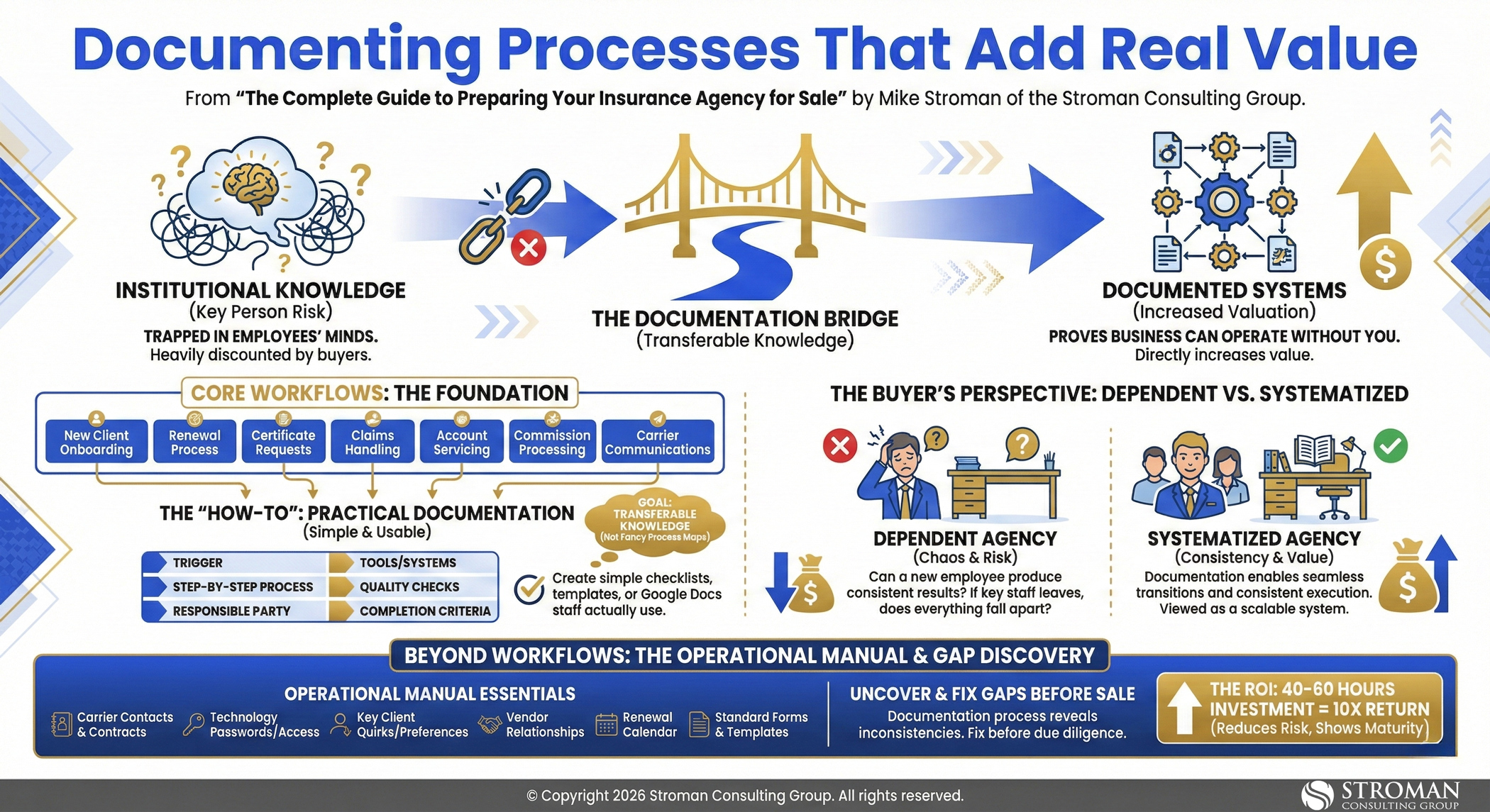
Most agencies operate based on institutional knowledge trapped in employees’ minds—especially owners. This creates a significant key person risk that buyers heavily discount. Documented systems prove the business can operate without you, which directly increases valuation.
Begin with your core workflows: new client onboarding, renewal process, certificate requests, claims handling, account servicing, commission processing, and carrier communications. For each workflow, document the trigger that starts it, the step-by-step process, who’s responsible for each step, the tools or systems used, the quality checks along the way, and the completion criteria.
Don’t hire a consultant to build fancy process maps nobody uses. Create working documents your staff actually references—simple checklists, templates, or even Google Docs with step-by-step instructions. The goal isn’t beautiful documentation; it’s transferable knowledge.
Here’s what makes documentation valuable to buyers: Can a new employee follow your procedures and produce consistent results? If your senior account manager leaves, can someone step into that role using your documentation without everything falling apart? The answers to these questions determine whether buyers view your agency as a system or as dependent on specific individuals.
Beyond process documentation, create an operational manual covering: carrier contacts and contract details; technology passwords and access; key client quirks and preferences; vendor relationships and contracts; a renewal calendar; and standard forms and templates used.
The documentation process itself reveals gaps in your business. When you try to write down “how we handle renewals,” you might discover there is no standard process—everyone does it differently. That’s a problem you can fix before sale rather than having buyers discover it during due diligence. Budget 40-60 hours to create basic but solid documentation across all major processes. This investment typically returns 10x during the sale by reducing buyer concerns about key person risk and demonstrating operational maturity.
The emotional side of selling your insurance agency
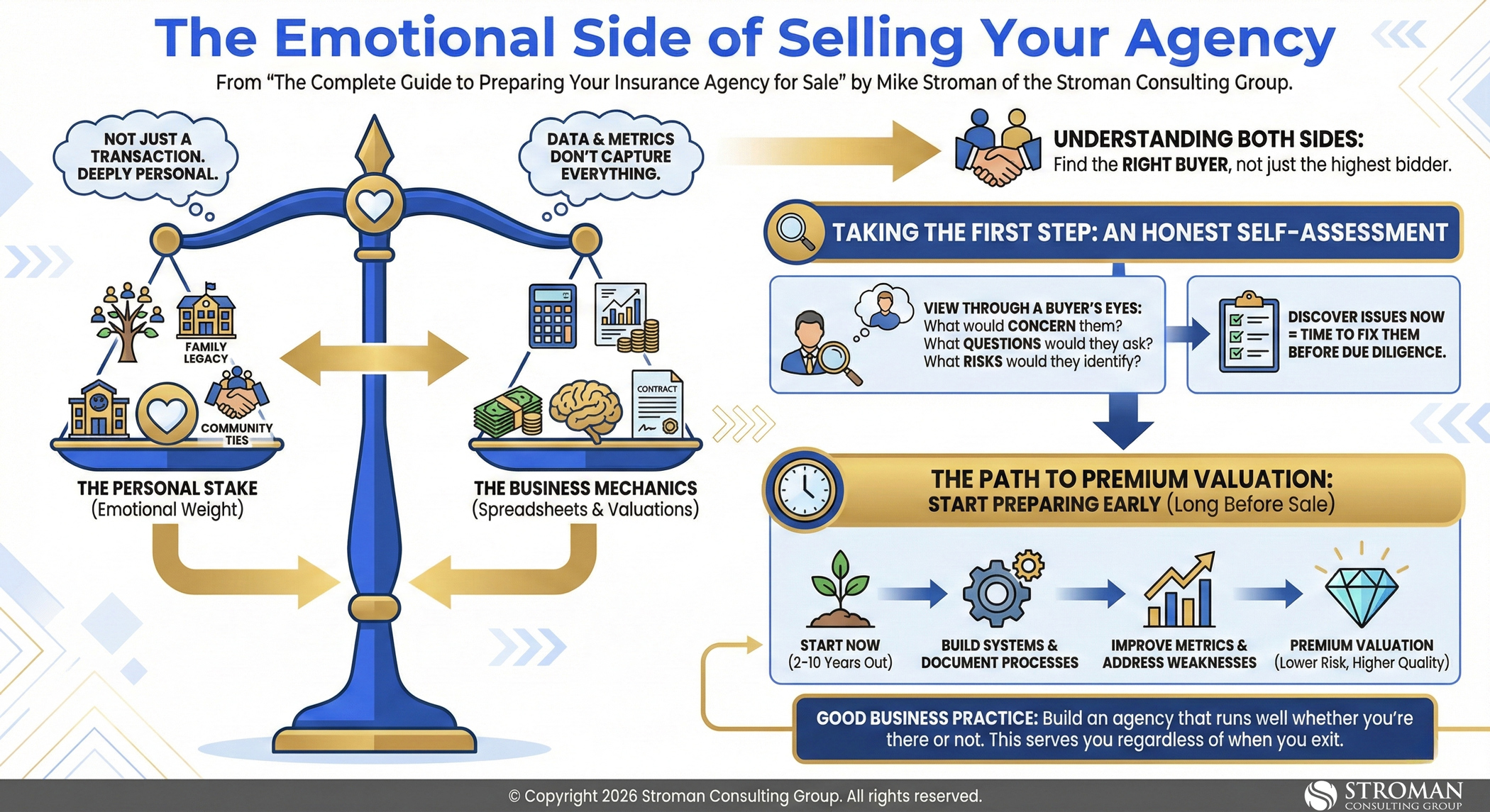
For many agency owners, this isn’t just a business transaction—it’s deeply personal. When your agency has been in your family for decades, or when you’ve built it from scratch and watched it become part of your community, the decision to sell carries emotional weight that spreadsheets and valuations don’t capture.
“Our agency has been around since the 1930s and 1940s—we’re talking three generations of clients and deep community relationships. We wanted to sell at the top of our game, not because we had to… This wasn’t just a transaction for us—we cared deeply about our employees and our clients being taken care of.”
— Deni Townsend, Third-Generation Agency Owner
This emotional component is precisely why working with someone who understands both sides—the business mechanics and the personal stakes—makes such a difference. The best outcomes happen when sellers can focus on finding the right buyer, not just the highest bidder.
“This was my father’s business—over 42 years in our family—so I had real concerns about doing this the right way… Hiring Mike gave me incredible peace of mind—selling my insurance agency was well outside my expertise, and I simply didn’t have time to figure it all out while still running the business day to day.”
— Ken Pickett, Agency Owner
Taking the first step
Understanding how to sell your insurance agency effectively starts with an honest self-assessment. Look at your agency through a buyer’s eyes: What would concern them? What questions would they ask? What risks would they identify? The issues you discover now are the same ones buyers will find during due diligence—but you have the advantage of time to fix them.
The owners who achieve premium valuations share one characteristic: they started preparing long before they were ready to sell. They built systems, documented processes, improved metrics, and addressed weaknesses while there was still time to show results. When they finally went to market, their agencies represented lower risk and higher quality—and buyers paid accordingly.
“Four years later, I’m fully retired (as planned!), and Billy still works four days a week because he wants to. Everything worked out exactly as we hoped.”
— Deni Townsend, Agency Owner
Whether you’re planning to sell in two years or ten, the time to start preparing is now. Track your metrics, document your processes, address your weaknesses, and build an agency that runs well whether you’re there or not. That’s not just good sales preparation—it’s good business practice that will serve you regardless of when you eventually decide to exit.
Ready to prepare your agency for maximum value? Get our free roadmap at stromanconsultinggroup.com. Our roadmap includes specific checklists for organizing financial documents, improving operations, and addressing potential issues before they’re brought to the buyer’s attention.


